
Wake Forest launches new journal focused on service-learning and community engagement
The Office of Civic and Community Engagement, in partnership with North Carolina Campus Engagement, announced the launch of Catalyst: An Interdisciplinary Journal of Service-Learning and Community Engagement on July 23, 2026. The journal’s inaugural issue, “Sustaining Civic Joy in Challenging Times,” is now live and freely available at catalyst.pubpub.org.
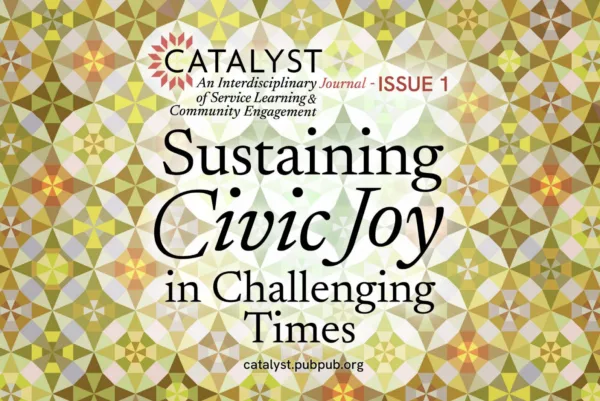
Catalyst is an open-access, peer-reviewed journal amplifying the voices of practitioner-scholars, community-based researchers, faculty, staff, students, and community leaders working at the intersection of higher education and community-engaged scholarship. Issue 1 brings together research articles, case studies, community partner profiles, and creative work exploring how joy functions not as a luxury but as an essential, sustaining force for individuals and communities navigating uncertainty, disruption, and inequity.
Contributors span institutions across the country and abroad, examining civic joy through lenses including HIV/AIDS care work in the U.S. South, Indigenous-led service-learning partnerships in Australia, rural arts-based civic engagement, and the lived experience of Black girlhood. The issue also features creative work from Wanda Balzano, an ACE Fellow in Wake Forest’s Department of English, reflecting Catalyst‘s commitment to publishing scholarship in multiple forms.
The journal was brought to life through cross-campus collaboration: Kyle Denlinger of Wake Forest’s Z. Smith Reynolds (ZSR) Library provided the technical publishing expertise behind the open-access platform, while Jennifer Gentry, an ACE Fellow in the Department of Art, served as graphic designer, shaping Catalyst‘s visual identity.
“Joy in times of crisis is not optional,” said Allison Walker, managing editor of Catalyst and director of Community Partnerships and Experiential Learning at Wake Forest University. “This issue reflects years of listening to practitioners, faculty, and community partners who kept telling us the same thing: that joy sustains this work, especially in the hardest moments.”
Leslie Garvin, Executive Director of North Carolina Campus Engagement and guest editor of Issue 1, added: “Catalyst exists because our field needed a space that could hold both rigorous scholarship and the full humanity of the people doing this work. Issue 1 is proof of what’s possible when we make room for both.”
Catalyst received funding support from the Wake Forest Provost’s Office. All content is published under a Creative Commons open-access license and will remain freely available in perpetuity.
Submissions are now open for Issue 2, themed “Our Democratic Imagination: Who Will We Be in the Next 250?”, guest edited by Dr. Timothy Eatman, Professor and Inaugural Dean of the Honors Living-Learning Community at Rutgers University–Newark. Full submission guidelines are available at catalyst.pubpub.org.
Categories: Happening at Wake, Research & Discovery, University Announcements